Québec Transports Pregnant Prisoners in Vehicles With No Seatbelts. I Have the Document.

I recently asked Québec’s correctional authorities a simple question: how are pregnant incarcerated women transported, and what protects them if the vehicle crashes?
The answer, obtained through an access-to-information request, was direct and deeply troubling.
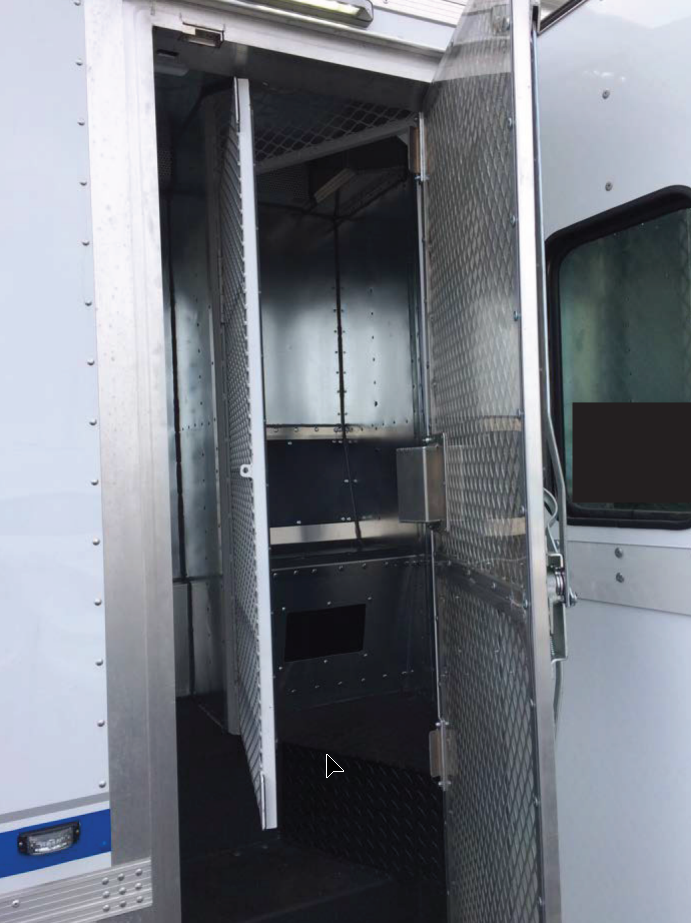
Québec identified the vehicles used for prisoner transport: Chevrolet vans, Ford cube vehicles, and Nissan two-seat minivans. About them, the ministry wrote:
“These vehicles are not equipped with seatbelts or another occupant-restraint system. All of these vehicles are used to transport pregnant women, where applicable.”
I had assumed pregnancy would trigger, at minimum, some form of additional passenger-safety accommodation.
Instead, I learned that pregnant women in custody can be transported in the same kinds of cellular vehicles that had already disturbed me deeply before I ever thought to ask about pregnancy specifically.

The justification
I asked the ministry how it justified this.
Its media-relations team pointed to sections 395.1 and 396 of Québec’s Highway Safety Code, which provide exemptions from seatbelt installation and use requirements for passengers in the rear of cellular vans.
The ministry said these exemptions reflect risks that seatbelts could pose to correctional staff and to incarcerated people themselves.
It also said transport decisions are made case by case. A pregnant incarcerated person could, for example, be seated in an individual section directly behind the driver to maintain direct and continuous communication during transport. The ministry said other possibilities could include an adapted vehicle intended for people with reduced mobility, a private adapted transporter, or an ambulance.
Then came the sentence that matters most:
“No changes to the configuration of cellular vehicles or to the transportation practices for pregnant incarcerated people are currently underway.”
The ministry was unusually direct in its response, and I want to acknowledge that.
But transparency about a policy is not a defense of it.
A legal exemption answers the question “Is this permitted?”
It does not answer the question I actually care about:
Why is transporting a human being with no occupant-restraint system considered acceptable in the first place, and why is there not at least some basic safety exception for pregnant prisoners?
How I got here
My interest in this issue did not start with pregnancy.
I have been interested in criminology for roughly twenty years, since university, particularly in how society responds to people who cause harm, become violent, or otherwise come into conflict with the law.
More recently, while reading reports from the Office of the Correctional Investigator alongside first-hand accounts from incarcerated people, I was trying to answer a broader question: does incarceration, as currently practised, actually help people become better citizens when they return to society?
I have increasingly come to doubt that it does.
One issue surfaced again and again, both in official reports and in personal accounts: transportation.
People described it as unsafe, painful, isolating, degrading and sometimes traumatic. The Office of the Correctional Investigator has also raised concerns about escort vehicles and passenger safety in three separate reports over the past decade.
What I kept encountering, in report after report and account after account, were descriptions and images of people locked inside enclosed metal compartments fitted into cargo vehicles: stark metal benches, very little visibility outside, and limited ability to communicate with the people transporting them.
I wanted to know: is this an exceptional measure reserved for extreme security cases, or is this simply how incarcerated people are routinely moved?
And underneath that was an even more basic question:
Why were these vehicles designed this way at all?
Why no ordinary passenger seating?
Why so little visibility?
What protects a person sitting on a metal bench during hard braking or a collision?
Can someone in the back reliably tell the officers up front that they are having a medical emergency?
Cameras are sometimes offered as the answer to that last question.
But being observable is not the same as being able to communicate distress.
A camera can show that someone is present. It does not necessarily tell staff that a person is overheating, struggling to breathe, having chest pain, panicking, losing consciousness, or being hurt by a restraint.
Where the argument often ends up
When I raise these concerns, I hear operational explanations.
Seatbelts can be damaged or turned into weapons.
Ordinary interiors can be vandalized.
More restrictive compartments may be considered necessary for security.
Those are claims worth examining seriously. I do not dismiss them out of hand.
But the conversation often does not stay there.
Eventually, the justification shifts from what is operationally necessary to who is inside the vehicle:
They are prisoners.
They did bad things.
They made their choices.
That is the part I cannot accept.
Security requirements can justify some restrictions.
They do not make preventable suffering irrelevant.
A conviction does not erase a person’s interest in surviving a collision, being able to say “I need help” and be heard, or being transported with basic human dignity.
Pregnancy does not erase that interest either.
Québec has confirmed, in writing, that the identified prisoner-transport vehicles are not equipped with seatbelts or another occupant-restraint system, and that pregnant incarcerated women may be transported in them where applicable.
It has also confirmed that no changes to the configuration of cellular vehicles or to the transportation practices for pregnant incarcerated people are currently underway.
The law may permit that.
That does not make the safety and moral questions disappear.
Continuing the practice is still a policy choice.